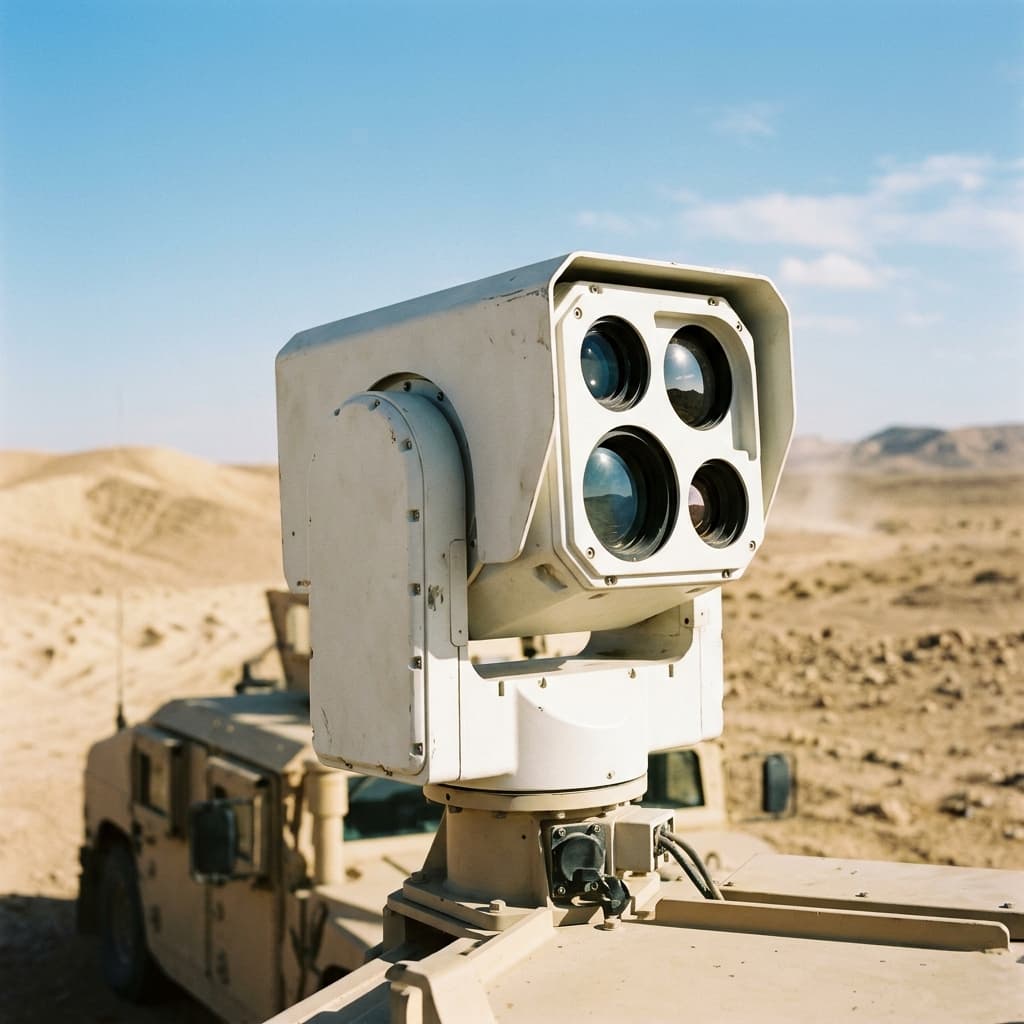
Core Technologies
Explore the fundamental physics, optical engineering, and artificial intelligence architectures behind our electro-optical systems. Superiority in the modern battlespace depends on how you process light and data.
Multi-Spectral Image Fusion for Visualizing Targets Behind Glass
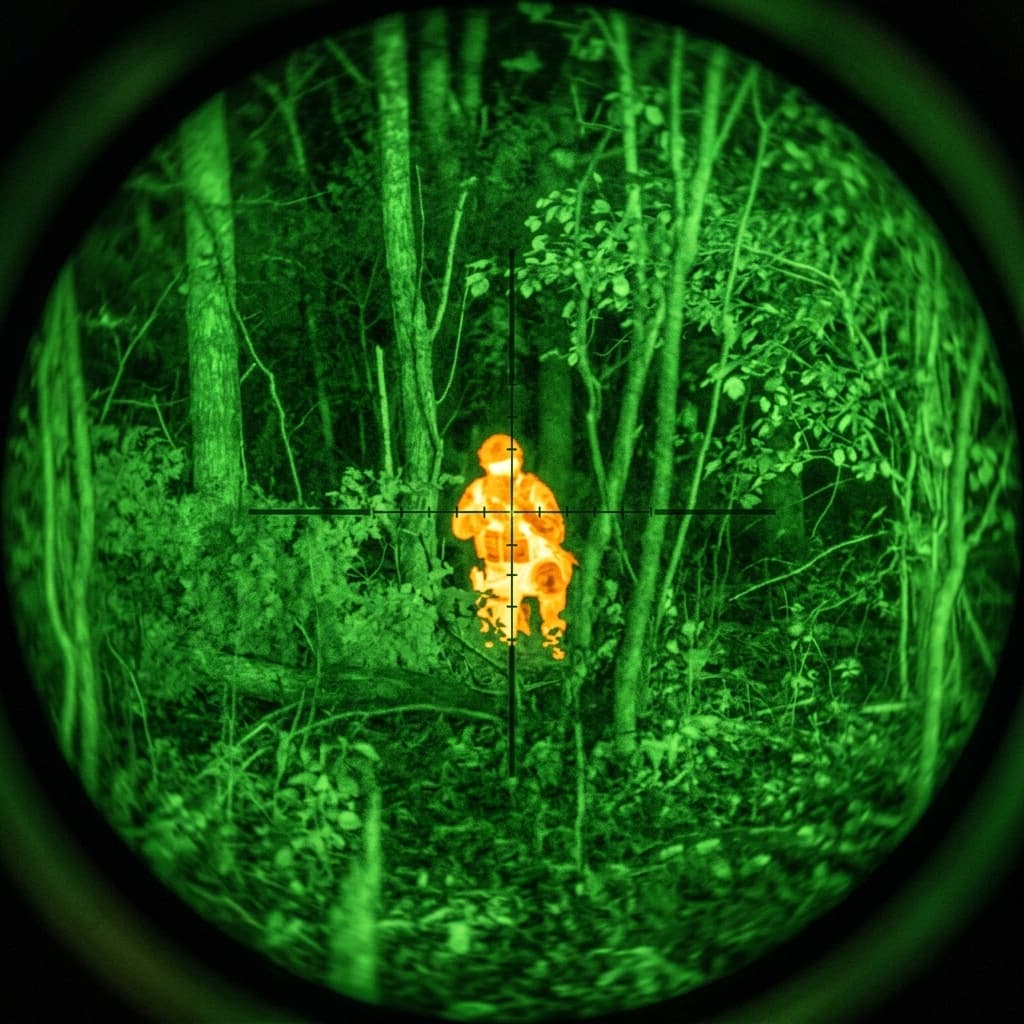
Night vision systems are not composed of a single sensor technology. Visible band cameras, low-light cameras, near-infrared (NIR), short-wave infrared (SWIR), and thermal cameras operate in different regions of the electromagnetic spectrum. Whether a camera system can image objects behind glass depends on the operating wavelength of the sensor used and the optical transmittance of the glass.
1. Behavior of Glass in the Infrared Spectrum
Standard window and vehicle glass largely transmit visible light. In contrast, traditional thermal cameras mostly operate in the following bands:
- MWIR (Mid-Wave Infrared): 3–5 µm
- LWIR (Long-Wave Infrared): 8–14 µm
Standard glass heavily absorbs or reflects radiation, especially in the LWIR region. The electromagnetic energy reaching the camera can be expressed by the following relationship:
τ(λ): spectral transmittance | ρ(λ): spectral reflectance | α(λ): spectral absorptance.
In the LWIR region, the value of τ is quite low. Therefore, the statement "a thermal camera cannot see behind cold glass" is technically incorrect; the fundamental issue is not the surface temperature, but the spectral transmittance characteristics of the glass.
2. Basic Principle of Image Fusion
Multi-spectral image fusion is the combination of complementary information obtained from sensors observing the same scene in different bands:
Here IV is the visible/low-light image, IIR is the thermal image, and ℱ is the fusion algorithm. The goal of fusion is not simply to overlay two images transparently; it is to produce a joint representation that preserves the spatial details in the visible image and the target salience in the thermal image.
"A multi-spectral fusion system can display targets that the thermal sensor cannot observe due to glass, through information obtained from visible, low-light, NIR, or SWIR sensors that can penetrate the glass. This process does not eliminate the physical limits of the thermal sensor; it fills the gaps in the sensor architecture using data science."
3. Image Alignment and Registration Process
Before fusion, images from different sensors must be geometrically aligned. The position of a point from the visible image in the thermal image is calculated via the homography matrix:
Because cameras are physically located in different positions, parallax, different fields of view, and lens distortion can lead to inaccurate registrations (double edges, ghosting). Our cross-modal feature matching systems correct these errors using artificial intelligence, providing zero-latency real-time alignment.
4. Decision-Level Deep Learning Fusion
Our systems fuse not just pixels, but targets. Each sensor produces its own target detection result, and the final decision is combined based on confidence scores:
For example, while the visible channel may detect a human behind glass, the thermal channel might not. The algorithm detects this target but does not falsely label it as "thermally verified."
Proposed System Architecture & Hardware
- High-resolution day camera & Low-light CMOS camera
- Active-illuminated NIR or InGaAs-based SWIR camera
- MWIR or LWIR thermal camera
- Hardware time synchronization (PTP/NTP supported)
- Real-time cross-modal image registration and task-adaptive fusion engine
Next-Gen Detectors (MWIR, LWIR, SWIR)
Our optical payloads are not dependent on a single spectrum. To guarantee performance in pitch darkness, heavy fog, and dust storms where visibility drops to zero, we use detectors operating at different wavelengths.
- SWIR (Short-Wave Infrared, 0.9–1.7 µm): Excellent at penetrating haze, fog, and smoke. It can see through standard glass and detect covert laser designators.
- MWIR (Mid-Wave Infrared, 3–5 µm): These cryogenically cooled detectors offer exceptional thermal contrast, enabling ultra-long-range target detection, especially on naval and airborne platforms.
- LWIR (Long-Wave Infrared, 8–14 µm): With uncooled microbolometer technology, it contains no moving mechanical parts and provides instantaneous response in dust clouds and Urban Warfare scenarios.
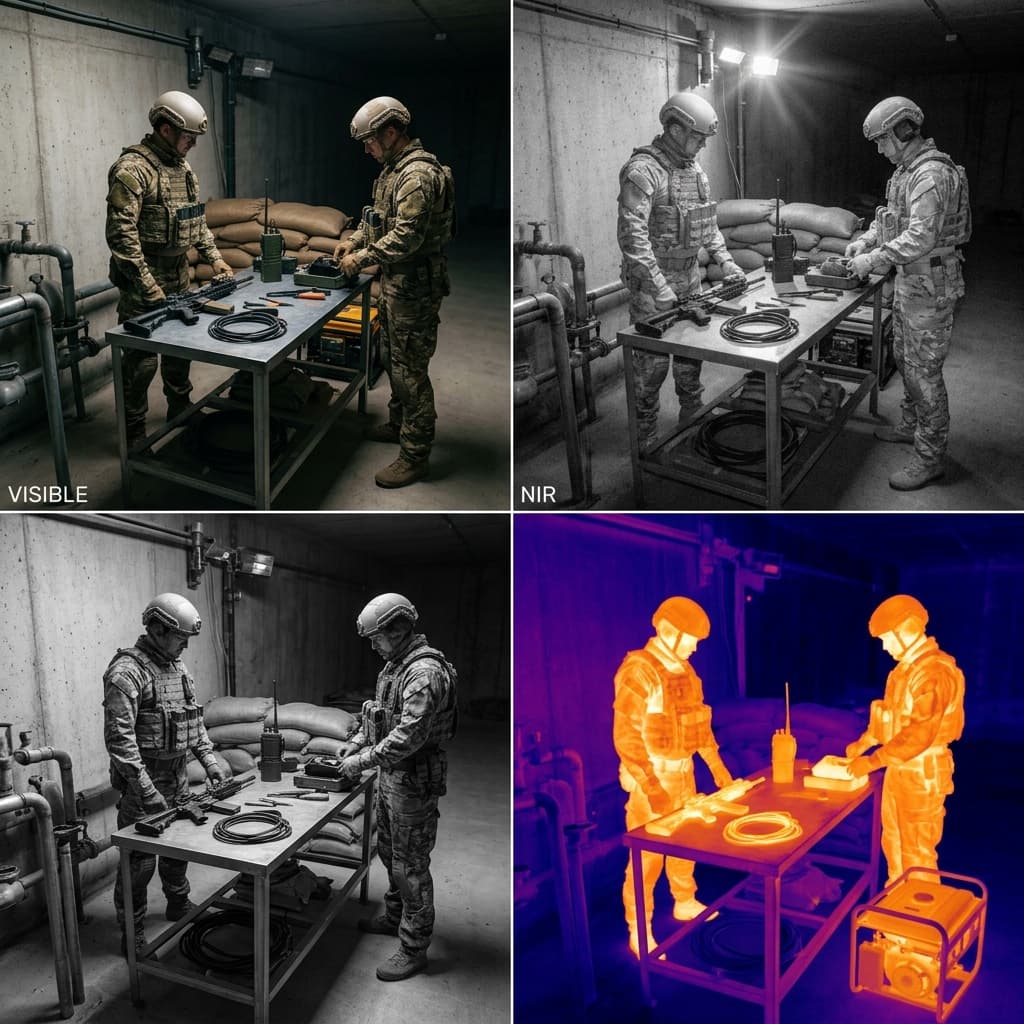
Precision Pan-Tilt & Gyro-Stabilization
You can have the best sensor in the world, but if your Line-of-Sight is vibrating, that sensor is blind. Our precise mechanical engineering produces ultra-sensitive Pan-Tilt units and Gimbal systems that completely isolate optics from platform vibrations.
Using direct-drive brushless DC torque motors, high-resolution optical encoders, and Fiber-Optic Gyroscopes (FOG), we achieve sub-micro-radian pointing accuracy. A Main Battle Tank charging over rough terrain or an UAV in heavy turbulence... No matter how the platform shakes, the target remains dead-center on the screen at all times.