Modular sensing capabilities for multi-domain environments.
OHMARIS develops ruggedized electro-optical systems, thermal imaging cores, and integrated sensor payloads. Our engineering focus spans from man-portable night vision to gimbal-stabilized airborne platforms, ensuring operational superiority through uncompromising hardware design.
Electro-Optical Surveillance
Long-range, multi-spectral observation platforms designed for persistent intelligence gathering. OHMARIS integrates high-definition day sensors, advanced thermal imaging, and edge-processing algorithms into unified architectures to provide operators with clear target identification under degraded visual environments.
Our system-level approach ensures that surveillance payloads are inherently scalable, allowing for rapid integration into fixed command centers, mobile reconnaissance vehicles, and maritime vessels without requiring extensive architectural redesign.
Targeting & Laser Systems
Precision engagement relies on absolute accuracy. OHMARIS develops electro-optical targeting architectures incorporating eye-safe laser rangefinders (LRF), laser target designators (LTD), and near-infrared (NIR) pointers.
By fusing laser telemetry data directly with ballistic calculation modules and thermal imagery, our systems provide rapid target acquisition and engagement coordinate generation for both dismounted infantry and armored vehicle fire control systems.
360° Situational Awareness
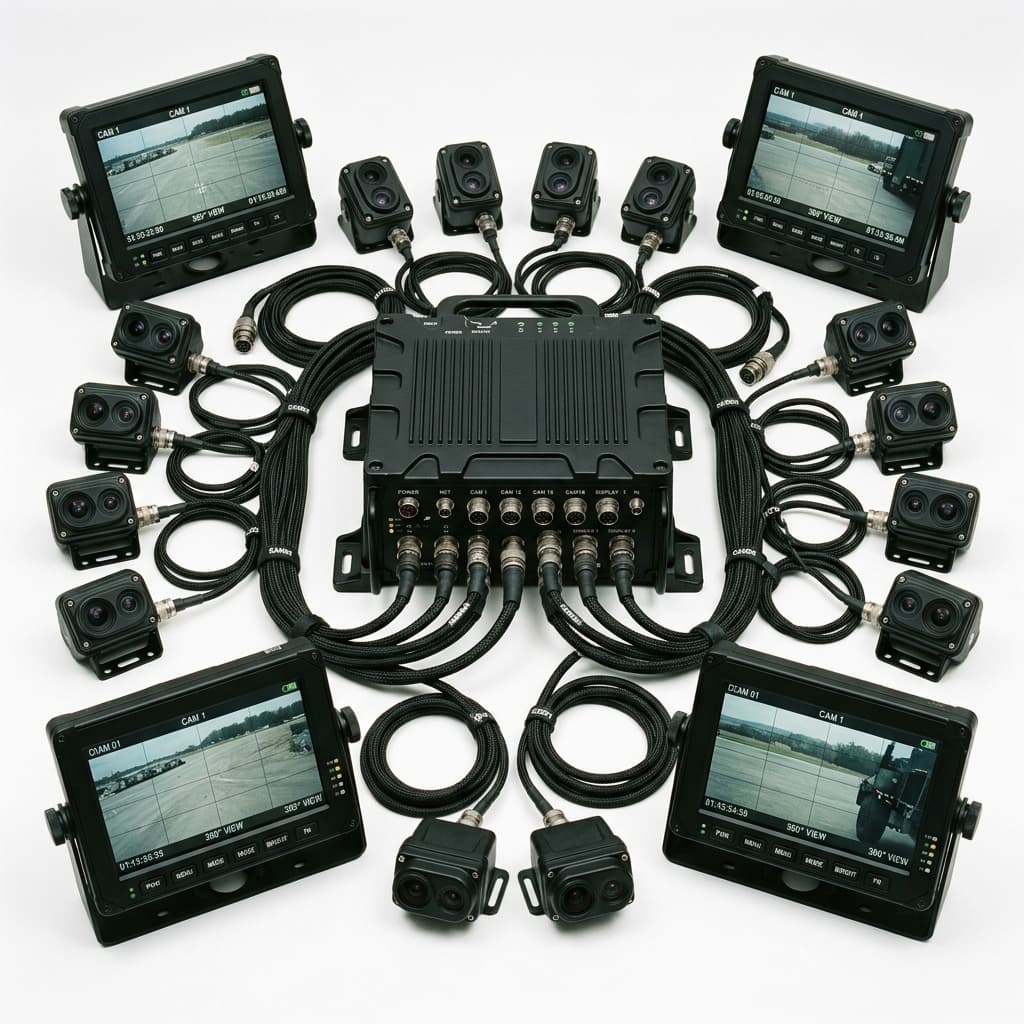
Closed-hatch operations in armored vehicles severely restrict crew visibility, increasing vulnerability to close-range threats. OHMARIS engineers modular, low-latency 360° Situational Awareness Systems centered around a ruggedized, military-grade DVR processing unit.
The central architecture distributes processing power, seamlessly stitching feeds from up to 12 distributed camera nodes (incorporating both day and night vision sensors) into a unified panoramic display, fed instantly to 4 dedicated crew interfaces (Commander, Driver, and Personnel screens).
- System Nodes1x Central DVR, 12x Day/NV Cameras, 4x Displays
- Sensor FusionDay / Low-Light Seamless Stitching
- LatencyGlass-to-Glass < 40ms
Operating flawlessly under extreme shock, vibration, and EMI conditions defined by MIL-STD-810 and MIL-STD-461, the system ensures total crew survivability and threat detection in urban combat environments.
Airborne EO/IR Systems
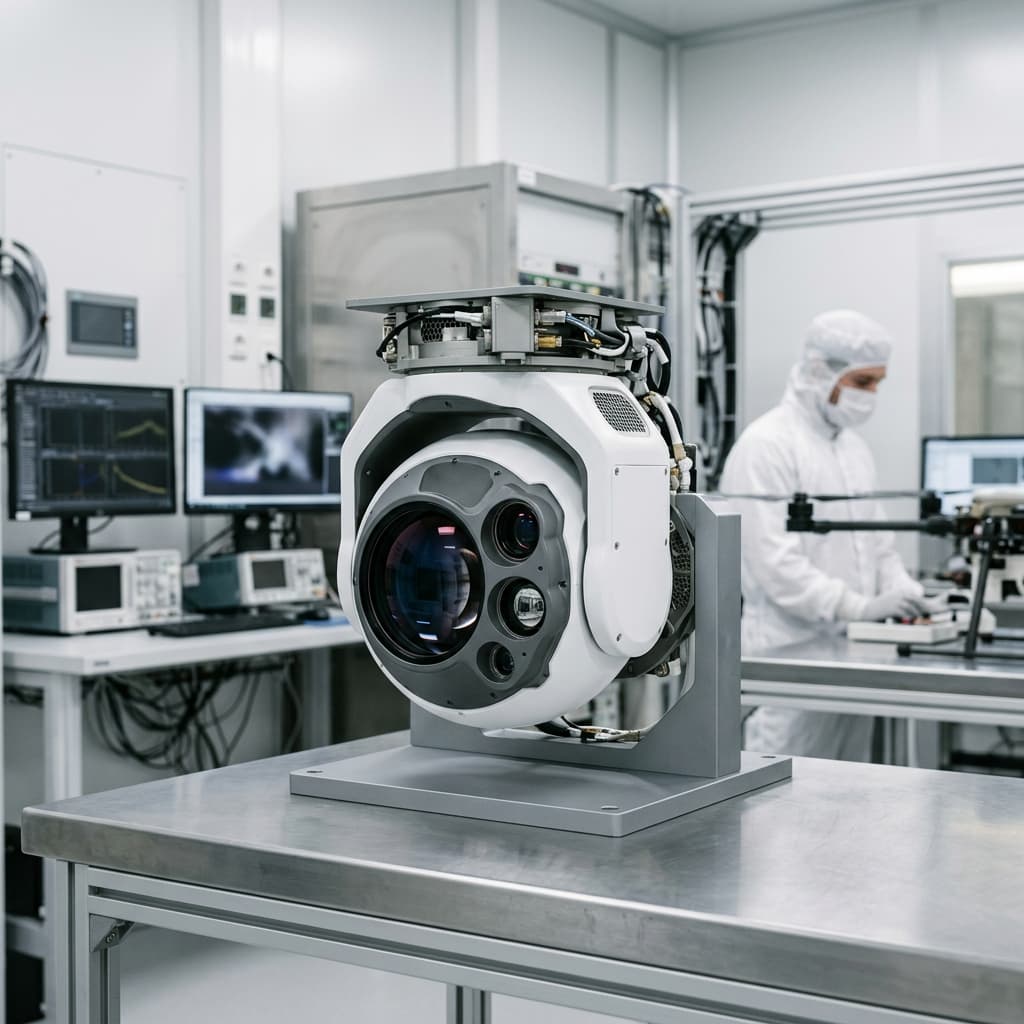
Airborne platforms impose severe constraints on size, weight, and power (SWaP), while demanding exceptionally high levels of stabilization. OHMARIS is developing multi-axis stabilized gimbal architectures for rotary-wing, fixed-wing, and unmanned aerial vehicles (UAVs).
- StabilizationDirect-Drive BLDC / FOG
- PayloadsMWIR, EO, LRF, Laser Pointer
- TrackingAI-Assisted Video Target Tracking
Our internal R&D focuses on advanced gyro-stabilization techniques, ensuring jitter-free imagery at maximum optical zoom, critical for long-range ISTAR (Intelligence, Surveillance, Target Acquisition, and Reconnaissance) missions.
Border & Perimeter
Securing vast national borders and critical infrastructure requires persistent, automated threat detection. OHMARIS’s perimeter security solutions utilize continuous-rotation pan-tilt units paired with ultra-long-range continuous zoom lenses.
Integrated with ground surveillance radar (GSR) and seismic sensors, our electro-optical nodes act as the primary visual verification layer, automatically slewing to radar tracks and utilizing AI-driven edge analytics to filter false alarms and classify intruders in real-time.
Night Vision Systems
Traditional image intensification (I2) remains a cornerstone of individual infantry capability. OHMARIS engineers ergonomic, lightweight, and extremely rugged night vision goggles (NVG) and monoculars.
Our development approach emphasizes not just optical clarity, but the mechanical durability of the housing, battery longevity in sub-zero environments, and seamless integration with ballistic helmets and weapon-mounted infrared illuminators.
Thermal Observation
Thermal imaging is the ultimate equalizer on the modern battlefield, completely defeating traditional visual camouflage. OHMARIS focuses extensively on integrating uncooled Microbolometers (LWIR) and cooled (MWIR) thermal cores into man-portable observation devices and weapon sights.
- TechnologyCooled MWIR & Uncooled LWIR
- ProcessingAdvanced Dynamic Range Enhancement
We prioritize custom image processing pipelines implemented on FPGA architectures to deliver high-contrast, artifact-free thermal video, ensuring operators can detect thermal signatures through smoke, fog, and total darkness at exceptional ranges.
Unmanned Platform EO
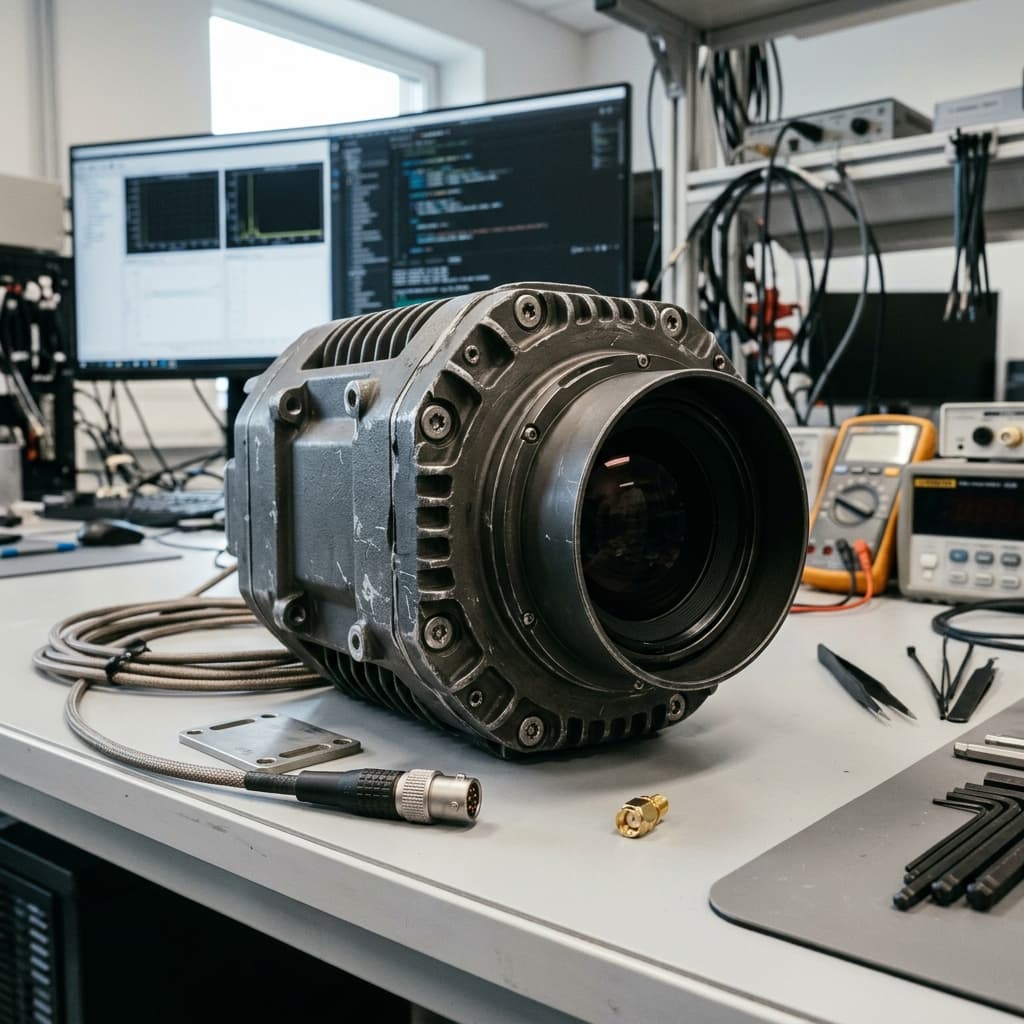
The proliferation of Unmanned Ground Vehicles (UGVs) and Unmanned Surface Vehicles (USVs) demands a new class of electro-optical sensors. These payloads must be exceptionally rugged to survive continuous vibration while maintaining a low profile.
OHMARIS designs SWaP-C optimized sensor suites specifically for autonomous and remotely operated platforms. Our systems feature high-speed data interfaces (GigE Vision, 3G-SDI) for low-latency transmission to remote operators, and internal edge computing for autonomous waypoint navigation and obstacle avoidance in GPS-denied environments.